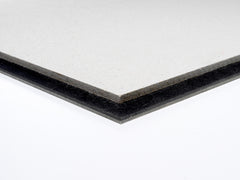
MAXI 60 CEILING 1-HOUR FIRE-RATED
Click Here To Download Technical Drawing
Click Here To Download Datasheet
.
Maxiboard can be installed onto a ceiling in order to meet Approved Document E of the Building Regulations (2003) and also achieves 1 hour fire protection. Firstly, 100mm Maxislab is friction-fitted between the joists. SRS Maxi Resilient Bars are then fixed to span the timber joists across the full width of the ceiling, using 70mm x 5mm self-drilling screws.
.
They are fitted at the edges of the ceiling and at a maximum of 300mm centres in between. The Maxiboard panels are fixed into the SRS Maxi Resilient Bars using 30mm x 3.9mm SRS Maxi Screws. Fixing must be to the SRS Maxi Resilient Bar alone and not through into the timber joists. The Maxiboards are secured in a staggered half panel overlap, with the 10mm white gypsum layer facing outwards, unless specification requirements determine otherwise.
.
The Maxiboards should be fixed to every resilient bar along their length. The screw fixings should be at a maximum of 300mm centres and no closer than 20mm to the edge of the board. A bead of SRS Gripfix is applied to each panel’s shiplap edge prior to installation.
.
Where the Maxiboard panels adjoin a perimeter wall, the shiplap edge should be removed, and a bead of SRS Acoustic Sealant applied to the edge. It is essential that no gaps occur between the Maxiboard panels. 15mm fire-rated plasterboards are then fixed through the Maxiboard and into the Maxi Resilient Bars using 50mm drywall screws.
.
MAXI 30 CEILING The Maxi 30 ceiling system is similar to the Maxi 60, but the centres of the Maxi Resilient Bars are increased to 400mm centres, and the 15mm fire-rated plasterboard is replaced with a layer of 9.5mm plasterboard.
.
HANDLING: Maxiboard is a very heavy product (17.28kg per sheet). Please exercise caution when lifting and installing. The HSE can provide information and guidance on the lifting and handling of heavy goods www.hse.gov.uk
.
Important Information
Sound Insulation Store are specialists in acoustics and sound insulation. All guidance, system information and predicted performance figures are provided for general assistance only.
It is the customer’s responsibility to ensure that the existing structure is suitable and compatible with any proposed sound insulation system. Where required, customers must seek advice from a structural engineer, building control, or another appropriately qualified professional.
Customers must also confirm whether their project requires specific fire resistance, structural, or regulatory compliance measures. Any fire, structural, or regulatory approval must be obtained independently from a competent specialist.
Sound Insulation Store has worked with NCPL to produce Insul prediction graphs and holds site test data on our Part E systems. These figures are intended as guidance only.
Actual on-site performance will vary depending on the condition and construction of the existing building, flanking transmission routes,installation quality, and any unforeseen site variables.
No performance level can be guaranteed unless independently tested on site after installation.