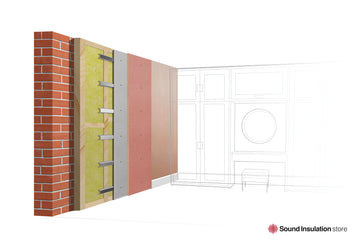
From the existing wall leave an airgap of at least 25mm. Then install your independent free standing stud wall, this can be timber of lightweight metal track and stud. Ensure the newly formed cavity is clear with no fixings.
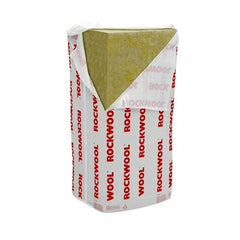
Install the appropriate depth of RWA45 Rockwool Insulation within the stud. E.G. If the stud is 50mm then use 50mm insulation. The deeper the stud and overall cavity the better the acoustic performance will be at low frequency.
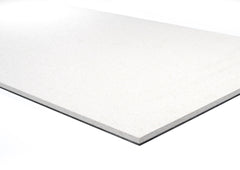
To the new stud install Maxi resilient bars. The bars can be installed at 600 centres horizontally. Fix the dBoard to the Maxi resilient bars and in a brick bond pattern. Use Maxi HP Screws 35mm to fix the dBoard to the resilient bars. Seal the perimeter of the dBoard around the edges where the board meets the wall, leave a 5mm expansion gap and infill with acoustic sealant. Over lay the dBoard with 15mm Siniat Fireline plasterboard. Seal the perimeter with acoustic sealant. The wall is then ready to be finished, with either wet plaster or tape a joint finish.
.
Important Information
Sound Insulation Store are specialists in acoustics and sound insulation. All guidance, system information and predicted performance figures are provided for general assistance only.
It is the customer’s responsibility to ensure that the existing structure is suitable and compatible with any proposed sound insulation system. Where required, customers must seek advice from a structural engineer, building control, or another appropriately qualified professional.
Customers must also confirm whether their project requires specific fire resistance, structural, or regulatory compliance measures. Any fire, structural, or regulatory approval must be obtained independently from a competent specialist.
Sound Insulation Store has worked with NCPL to produce Insul prediction graphs and holds site test data on our Part E systems. These figures are intended as guidance only.
Actual on-site performance will vary depending on the condition and construction of the existing building, flanking transmission routes,installation quality, and any unforeseen site variables.
No performance level can be guaranteed unless independently tested on site after installation.